
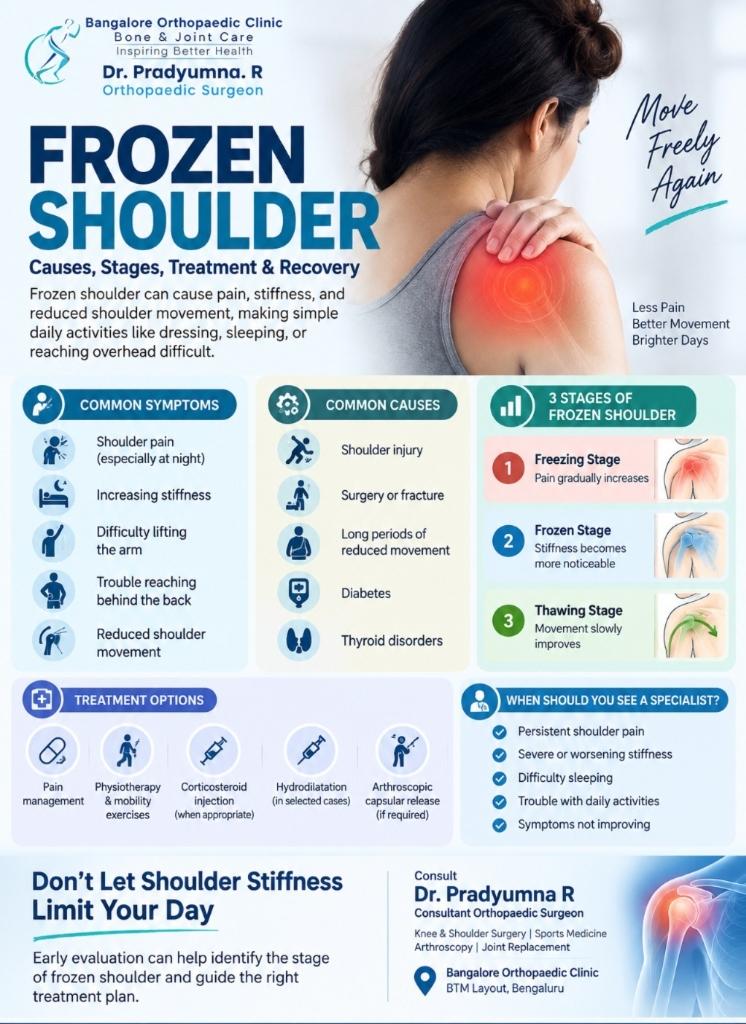
Get expert frozen shoulder treatment in Bangalore. Learn about causes, stages, and non-surgical recovery options. Book a consultation today!
Reviewed by: Dr. Pradyumna R
Frozen shoulder often starts quietly. You may first notice that reaching behind your back feels uncomfortable, sleeping on one side has become difficult, or lifting your arm to wear a shirt takes more effort than usual. Over time, the shoulder can become increasingly painful and stiff. Medically known as adhesive capsulitis, frozen shoulder is a condition in which the capsule surrounding the shoulder joint becomes inflamed, thickened and tight. This gradually restricts movement. One important thing to understand is that frozen shoulder does not behave exactly the same way in every person. Some people struggle mainly with shoulder pain, while others are more bothered by stiffness and loss of movement. Treatment therefore needs to be based on the stage of the condition, severity of symptoms and the person’s day-to-day limitations. For patients looking for frozen shoulder treatment in Bangalore, an accurate diagnosis is important because not every painful or stiff shoulder is necessarily a frozen shoulder.
What Is Frozen Shoulder?
The shoulder is a ball-and-socket joint surrounded by a flexible capsule. This capsule allows the shoulder to move through a wide range of motion. In frozen shoulder, the capsule becomes inflamed and gradually tightens. As this happens, movements such as lifting the arm overhead, rotating it outward or reaching behind the back become restricted.
A characteristic feature is restriction of both active movement, where you move the shoulder yourself, and passive movement, where the doctor or physiotherapist tries to move the shoulder for you. This distinction is useful because conditions such as rotator cuff injuries and supraspinatus tendinopathy can also make it painful to lift the arm, but the pattern of restriction may be different.
What Causes Frozen Shoulder?
Sometimes frozen shoulder develops without an obvious injury or event. This is known as primary or idiopathic frozen shoulder. In other situations, it may develop after the shoulder has remained relatively immobile for a period of time, such as following:
Frozen shoulder is also seen more commonly in people with certain medical conditions, particularly diabetes and thyroid disorders. This does not mean that everyone with these conditions will develop frozen shoulder. However, knowing a patient’s medical history can help the orthopaedic surgeon plan the evaluation and treatment appropriately.
The Three Stages of Frozen Shoulder
Frozen shoulder usually progresses gradually. The condition is commonly divided into three stages, although the boundaries between them are not always clear.
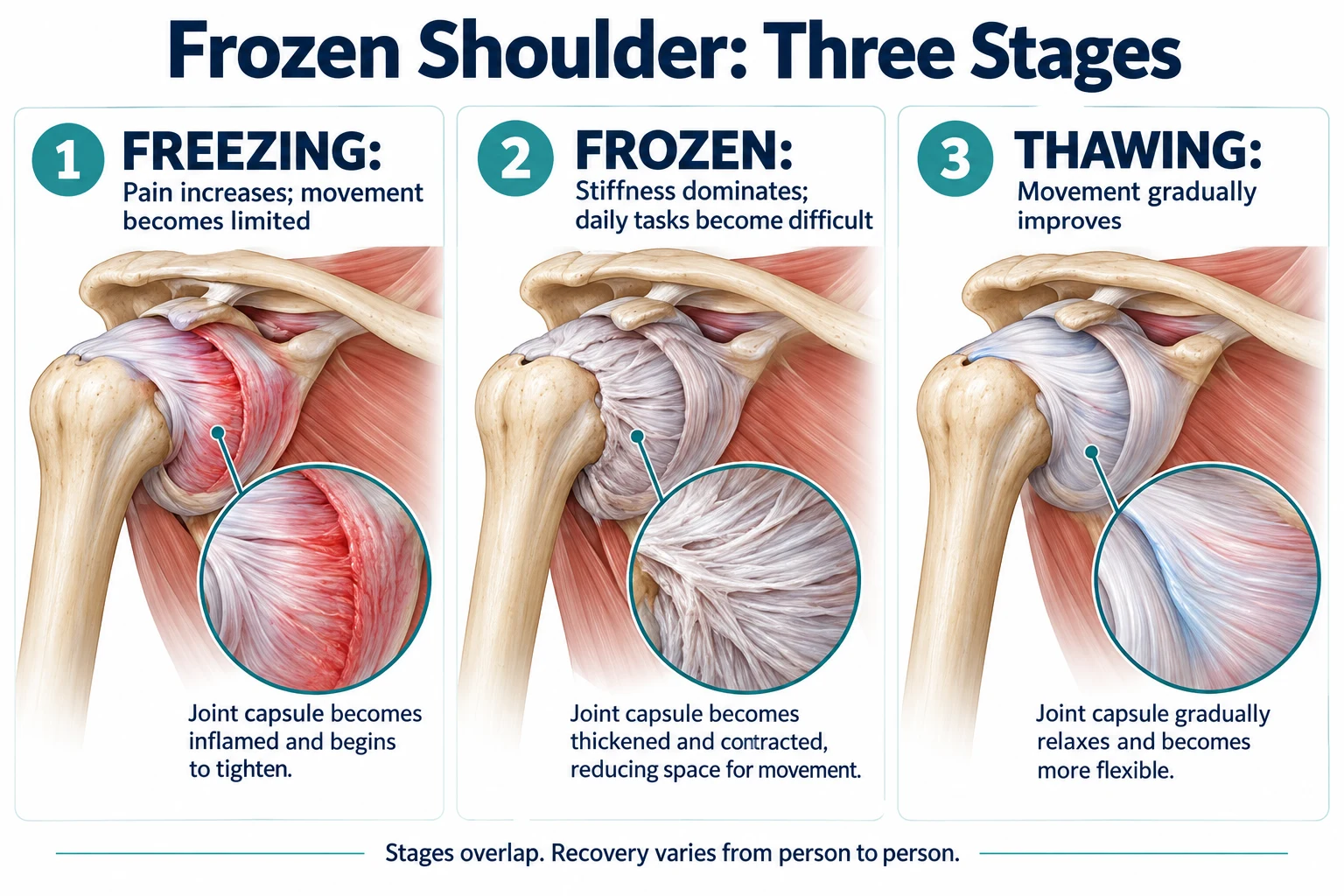
Frozen Shoulder: Three Stages
Frozen Shoulder: Three Stages. An illustrated summary of this article; individual assessment and recovery plans vary.
View full-size image (opens in a new tab)1. Freezing Stage
During the freezing stage, pain tends to be the main problem. Pain may gradually increase and can be particularly troublesome at night. Sleeping on the affected shoulder may become uncomfortable, and seemingly simple movements can produce sharp pain. At the same time, shoulder movement begins to decrease. During this stage, treatment often concentrates on managing pain while maintaining gentle movement. Very aggressive stretching of an already painful shoulder may be difficult to tolerate, so exercises need to be tailored accordingly. Read our guide on shoulder pain at night treatment in Bangalore.
2. Frozen Stage
As the condition progresses, pain may become less intense for some people, but stiffness becomes much more noticeable. Activities that were previously automatic can become frustrating. Patients may struggle to:
Physiotherapy and mobility exercises can play an important role during this stage, but the programme should still be adapted to the individual’s symptoms.
3. Thawing Stage
During the thawing stage, shoulder movement gradually begins to return. Everyday activities may become easier and the feeling of restriction slowly reduces. However, improvement is not necessarily rapid or perfectly consistent. Some weeks may feel better than others. The goal during this phase is generally to progressively restore comfortable movement and function.
How Is Frozen Shoulder Diagnosed?
Frozen shoulder is largely a clinical diagnosis. During an examination, the orthopaedic surgeon will assess how far you can move the shoulder yourself and how far the shoulder moves when it is moved passively. Particular attention is usually paid to rotational movements because these can become noticeably restricted in frozen shoulder. The assessment may also include:
An X-ray may sometimes be recommended to exclude other causes of shoulder stiffness, such as arthritis. Additional imaging may be considered when the symptoms or examination suggest another shoulder problem such as shoulder impingement or a labral tear.
Frozen Shoulder Treatment in Bangalore
Treatment should not simply be about “breaking” or forcing a stiff shoulder. The approach depends on whether the patient is predominantly experiencing pain, stiffness or both, as well as the stage of the condition.
Pain Relief and Activity Modification
During a painful phase, the first goal may be to make everyday activities and sleep more manageable. Medication may be recommended for some patients, depending on their health and medical history. Activities that repeatedly provoke significant pain may need to be temporarily modified. This does not necessarily mean completely resting the shoulder; prolonged avoidance of movement can contribute to further stiffness.
Physiotherapy for Frozen Shoulder
Physiotherapy is commonly included in frozen shoulder treatment. Exercises may focus on gradually improving:
The intensity of physiotherapy matters. A shoulder that is extremely painful during the freezing stage may not tolerate the same stretching programme as a shoulder in the later stages where stiffness is the main concern. For this reason, exercises should ideally be progressed according to symptoms rather than simply forcing the shoulder to move farther each day.
Corticosteroid Injection
A corticosteroid injection into the shoulder joint may be considered for selected patients, particularly when pain and inflammation are limiting movement and rehabilitation. The aim is generally to reduce symptoms sufficiently to allow more comfortable movement and physiotherapy. Whether an injection is suitable depends on the individual patient’s condition, medical history and stage of frozen shoulder.
Hydrodilatation
Hydrodilatation, also called capsular distension, is another option that may be discussed in selected cases. During the procedure, fluid is introduced into the shoulder joint under imaging guidance with the aim of stretching the tight capsule. It is not automatically required for everyone with frozen shoulder. The decision depends on the degree of stiffness, previous treatment and clinical findings.
When Is Surgery Considered?
Most patients are initially treated without surgery. However, if substantial stiffness continues despite an appropriate period of non-surgical treatment and is significantly affecting everyday life, surgery may be considered. One surgical option is arthroscopic capsular release. Using small incisions and a camera called an arthroscope, the surgeon releases selected tight portions of the shoulder capsule to improve mobility. Surgery is not simply recommended because someone has had frozen shoulder for a particular number of months. The decision is usually based on symptoms, functional limitations, examination findings and the response to previous treatment.
Managing Frozen Shoulder at Home
There are also practical ways to make the recovery period more manageable. Gentle shoulder movement within a comfortable range can help maintain mobility. Some people find a warm shower or gentle heat before exercises makes stretching more comfortable. When sleeping, supporting the affected arm with a pillow may reduce discomfort. Most importantly, avoid turning every exercise session into a test of how far you can push the shoulder. Exercises that repeatedly produce significant pain may need to be modified. If pain suddenly worsens, weakness develops, or the symptoms do not fit the usual pattern of frozen shoulder, reassessment is advisable.
Recovery Expectations
Frozen shoulder tends to improve gradually rather than overnight. Pain and movement may also recover at different speeds. A patient may notice that night pain improves while the shoulder still feels stiff, or that everyday activities become easier before full movement returns. Recovery can be influenced by several factors, including:
Rather than focusing on a fixed recovery deadline, progress can often be judged more practically: Is sleeping becoming easier? Can you reach higher? Is dressing less difficult? Is the shoulder interfering less with work and everyday life? These functional changes can provide a more realistic picture of recovery.
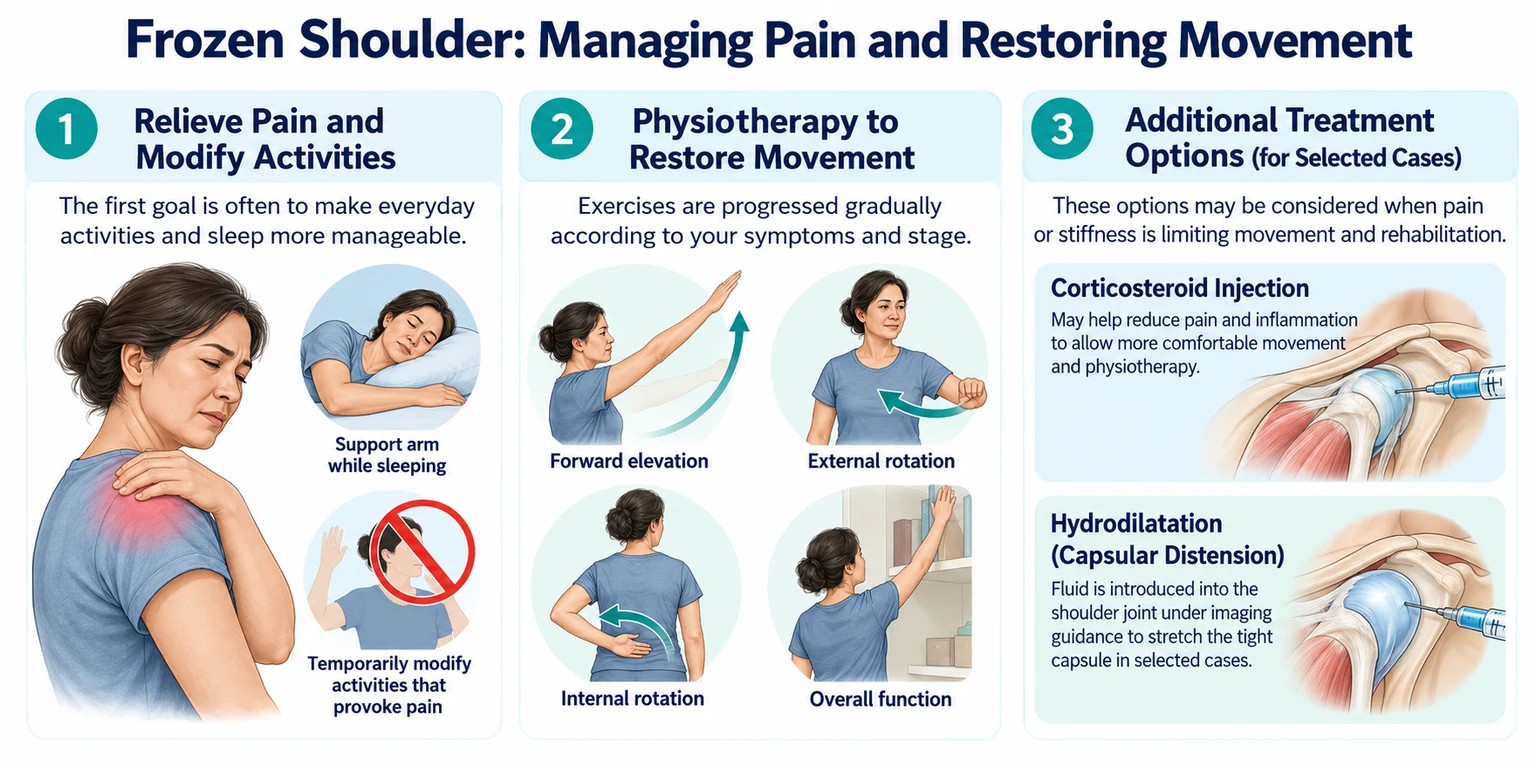
Frozen Shoulder: Managing Pain and Restoring Movement
Frozen Shoulder: Managing Pain and Restoring Movement. An illustrated summary of this article; individual assessment and recovery plans vary.
View full-size image (opens in a new tab)Conclusion
Frozen shoulder can make surprisingly ordinary activities difficult—from getting dressed to reaching a kitchen shelf or finding a comfortable sleeping position. The important point is that a stiff shoulder should first be properly diagnosed. Frozen shoulder can resemble other shoulder conditions, and treatment should be based on what is actually causing the restriction.
For confirmed frozen shoulder, treatment is usually adapted as the condition changes. Pain control may be more important during the early phase, while gradually restoring mobility becomes increasingly important as stiffness dominates. Physiotherapy, injections, hydrodilatation or, in selected persistent cases, surgery may form part of the treatment plan.
If shoulder pain and stiffness have been progressively limiting everyday activities, an orthopaedic assessment can help identify the cause and determine an appropriate next step.
For persistent shoulder pain, stiffness or difficulty with everyday movements, a clinical evaluation can help determine the cause, stage of the condition and suitable treatment options.
Dr. Pradyumna RConsultant Orthopaedic Surgeon | Knee & Shoulder Surgery | Sports Medicine | Arthroscopy | Joint Replacement
“Joint preservation and evidence-based conditioning are paramount. When surgical intervention is required, minimally invasive arthroscopy allows patients and competitive athletes to restore painless stability and confident motion.”
Frozen Shoulder Symptoms & Treatments
Stiff Shoulder Release & Arthroscopic Treatment | Dr. Pradyumna R. Watch Dr. Pradyumna R explain clinical diagnosis, surgical repair techniques, and recovery milestones.
Frequently Asked Questions
Frozen shoulder, or adhesive capsulitis, is a condition in which the capsule surrounding the shoulder joint becomes inflamed and tight. This leads to pain and progressive restriction of shoulder movement.

Dr. Pradyumna R
Verified SpecialistDr. Pradyumna R is a Consultant Orthopaedic Surgeon | Knee & Shoulder Surgery | Sports Medicine | Arthroscopy | Joint Replacement. He completed sub-specialty fellowship training in shoulder, elbow, and knee arthroscopy at the Technical University of Munich (TUM), Germany. He has performed over 5,000+ successful joint surgeries and practices at Bangalore Orthopaedic Clinic (JP Nagar) and Manipal Hospitals.